TL;DR
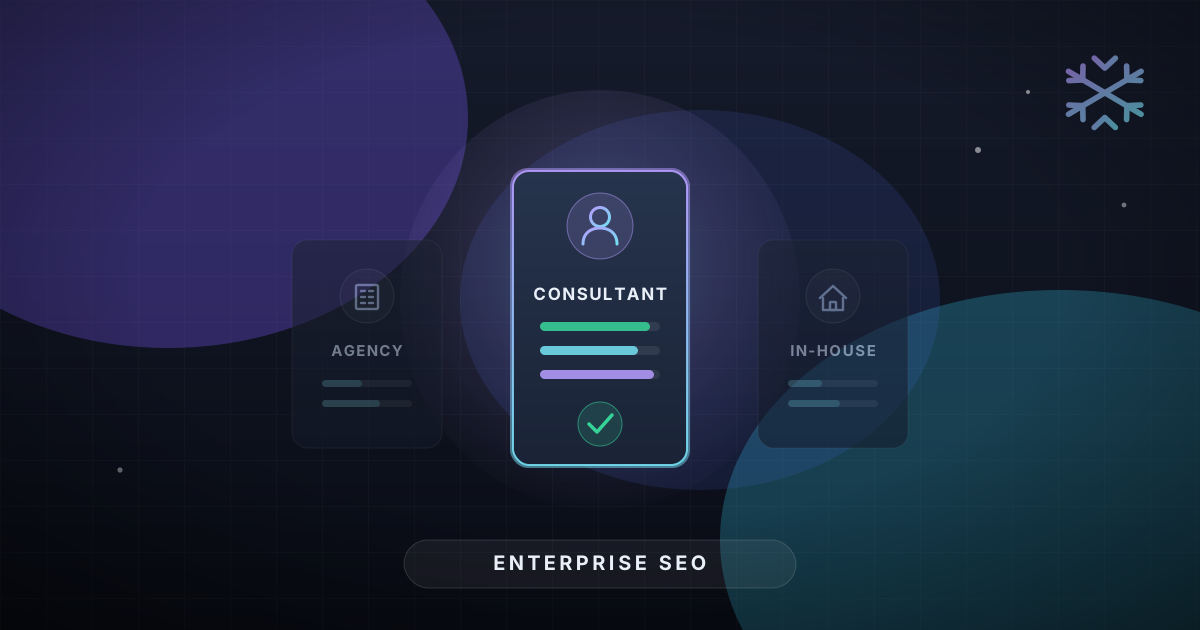
- There are three ways to run enterprise SEO — in-house, agency, or independent consultant — and they price out very differently.
- A fully staffed in-house team runs roughly $420K–$606K a year before tools, and only pays off at real scale (sustaining more than ~$15K–$20K/month of pure SEO work).
- Agencies sell senior expertise but deliver junior execution: a $20K retainer often buries just 10–15 senior hours inside a lot of junior work.
- A senior independent consultant (or a consultant-led hybrid) puts close to 100% senior hours on your account, embeds like an internal hire, and wins on value per dollar for most enterprises.
Table of Contents
If you're a CMO weighing how to run organic search at scale, you've probably been pitched all three options. An agency tells you they've got a whole team ready to go. A recruiter tells you to build in-house so you "own the capability." And somewhere in the mix, an independent consultant tells you they'll embed with your team and get more done for less.
They can't all be right. So let me cut through it.
I've spent years running enterprise SEO for brands across SaaS, ecommerce, media, and regulated industries. I've sat on the inside of these decisions, and I've watched companies spend half a million dollars a year and get less traction than a single embedded operator would've delivered. This isn't a neutral "it depends" piece. It's a breakdown of how the three models actually price out, who actually does the work, and why the independent consultant model wins for most enterprises most of the time.
Let's get into it.
First, the Stakes: Organic Search Is Your Command Center, Not a Line Item
Before we talk about who should run SEO, you need to be clear on what's riding on it. Organic search isn't one channel among many. It's the connective tissue of your whole omnichannel strategy. Your paid teams borrow your organic keyword data. Your content team lives or dies by what ranks. Your product pages, your help center, your blog, your category architecture, all of it runs through search.
BrightEdge research has consistently found that organic search drives the largest share of website traffic of any channel, far ahead of paid or social. And the global SEO software market was valued at roughly $74.6 billion in 2024 and is projected to hit $154.6 billion by 2030. Large enterprises make up more than half of that spend. This is not a place to wing it.
So the real question isn't "how do I check the SEO box." It's "what's the smartest way to put senior strategic horsepower on the channel that quietly feeds everything else." That reframe changes the answer.
Organic search is the command center of your entire marketing operation. Evaluate every staffing model through that lens.
Option One: Build It In-House (and Why the Math Rarely Works)
On paper, building in-house sounds like the grown-up choice. You own the capability. The team knows your brand. Nobody's juggling fifteen other clients.
Then you price it out.
A real enterprise SEO team isn't one person. It's an SEO director, a technical SEO specialist, a content strategist, and at least one analyst. Pull current salary data and the picture gets expensive fast. Glassdoor puts an SEO director's average compensation north of $150,000, and well into the $200,000s in major markets. Technical SEO specialists average over $108,000 per Glassdoor. Managers, analysts, content strategists, it all stacks up.
Directive pegged a fully staffed in-house enterprise team at roughly $420,000 to $606,000 a year "before a single piece of content is published." And that figure doesn't even include the parts that quietly kill your budget:
- Benefits, which typically run 25 to 35 percent on top of salary.
- Recruiting and ramp. It takes weeks to hire each role and months for a new hire to reach full productivity. You're paying full freight while they figure out where your GA4 properties live.
- The tool stack. Enterprise platforms like Botify, Conductor, and BrightEdge routinely run past $100,000 a year. Mid-market tools like Ahrefs, Semrush, and Screaming Frog add tens of thousands more.
- Single point of failure. Your director leaves and your entire institutional knowledge walks out the door with them.
Here's the thing nobody tells you: in-house only becomes the cost-effective choice at real scale. If you're sustaining more than roughly $15,000 to $20,000 a month in pure SEO work, a dedicated team starts to pay for itself. Below that, you're buying a Ferrari to drive to the mailbox. And even at that scale, the smartest in-house teams I've seen still keep a senior consultant on call to counter their own internal blind spots.
Option Two: Hire an Agency (and the Structural Problem Nobody Admits)
Agencies sell scale. A bench of specialists, broad tool access bundled in, the ability to spin work up and down. For pure high-volume execution across a lot of surfaces, that can genuinely be the right call. (If you're leaning this way, I've written a full guide on how to choose an enterprise SEO agency.)
But you need to understand how an agency actually makes money, because it explains everything about the experience you'll get.
Agency margins depend on leverage. Senior people sell, junior people execute. That's not a knock on any one agency, it's the business model. The strategist who wowed you in the pitch is rarely the person touching your account day to day. That's usually a junior account manager who might be juggling fifteen, twenty, even fifty accounts at once. When one strategist is spread across more than eight or so accounts, your program simply can't get the attention it needs.
This is the single most common complaint I hear from enterprise marketers who've been burned: they bought senior expertise and got junior execution. And it's structural, not accidental.
They bought senior expertise and got junior execution. With agencies, that gap is structural, not accidental.
Run the numbers and it gets worse. A "Tier 2" cross-functional enterprise retainer runs $15,000 to $30,000 a month, call it $180,000 to $360,000 a year. Agencies typically target gross delivery margins in the 50 to 70 percent range. So at a $20,000 monthly retainer, a big chunk of your check is markup and overhead, and only a sliver is senior strategist time actually applied to your account. You might be paying for thirty-plus hours and getting ten or fifteen hours of real senior thinking, with the rest filled in by people learning on your dime.
Then there's the relationship itself. Agencies operate as external vendors, which means there's a permanent coordination tax. Strategy, context, and expectations have to be re-transferred constantly. Over time that management overhead eats into the very time savings the agency was supposed to give you. And the churn data backs this up: Focus Digital's 2026 analysis found SEO agencies carry roughly 38 percent annual churn, with expectation gaps cited as a primary driver. Project-based SEO work churns even higher, around 42 percent.
When more than a third of clients are walking away every year, that tells you something about how often the vendor model actually delivers.
Option Three: The Independent Consultant (Why This Wins for Most Enterprises)
Here's where I'll show my hand. For most enterprises, a senior independent enterprise SEO consultant, or a consultant-led hybrid, delivers the best cost-per-value of the three models. Not because consultants are cheaper across the board, but because of what you're actually buying per dollar.
Let me break down the three reasons.
1. You Get Senior Hours, Not Junior Hand-Offs
This is the whole game. With a consultant, the person you interview is the person who shows up. There's no bench, no account manager layer, no bait-and-switch. You're buying close to 100 percent senior hours.
The rate data tells the story. The Ahrefs 2026 pricing survey of 439 SEO professionals found independent consultants average $171.18 an hour, versus $98.90 for agencies and $71.59 for freelancers. At first glance the consultant looks more expensive per hour. But that hourly rate is buying senior strategic judgment applied directly to your business, not blended team time where the senior rate subsidizes junior execution you didn't ask for.
Put it side by side. A $20,000 monthly agency retainer might deliver ten to fifteen senior hours buried inside a lot of junior work. A senior consultant at $6,000 to $15,000 a month delivers senior thinking on nearly every hour billed. For the strategic, judgment-heavy work that actually moves enterprise rankings, technical architecture, topical authority, the stuff juniors consistently get wrong, that difference is enormous.
For reference on the high end, Cyrus Shepard publicly lists a $6,000 monthly consulting fee, one of the few elite consultants who publishes a rate at all. Most senior independents engage by inquiry, and the top tier commands far more.
2. You Get Integration, Not a Vendor Relationship
A good consultant doesn't parachute in once a month with a slide deck. They embed. They join your weekly syncs, your sprint planning, your quarterly business reviews. They get direct access to your GA4, Search Console, GTM, BigQuery, and CMS. They sit inside your engineering backlog so technical fixes actually ship instead of rotting in a queue for three months.
This matters more than most CMOs realize, because enterprise SEO is fundamentally a cross-functional discipline. It touches dev, product, content, and analytics. And the cost of poor coordination is brutal. Gartner found that 84 percent of marketers experience high levels of "collaboration drag" from cross-functional work, and that organizations with high drag are 37 percent less likely to hit their revenue goals.
A siloed external agency makes that drag worse, because every handoff is a re-translation. An embedded consultant who's already inside your systems and your operating cadence collapses that gap. They become an extension of your marketing team rather than a vendor you have to manage.
3. You Keep the Capability When the Engagement Ends
This is the quiet advantage. Agencies retain the institutional knowledge, and sometimes they retain your data too. When the contract ends, the capability leaves with them.
A good consultant works the opposite way. They install systems, document playbooks, and coach your internal people to execute at a higher level. They leave your team stronger than they found it. You're not just renting outcomes, you're building durable internal muscle while you get the outcomes. That's a fundamentally better deal for a company that wants to own its growth long term.
So When Does Each Model Actually Make Sense?
I'm not going to pretend the consultant model wins in every scenario. Here's the honest framework I'd use if I were sitting in your chair.
| Model | Rough cost | Who does the work | Best when |
|---|---|---|---|
| In-house | $420K–$606K/yr before tools | Full internal team (director, technical, content, analyst) | You're at real scale (>$15K–$20K/mo of SEO) and want full strategic control |
| Agency | $180K–$360K/yr ($15K–$30K/mo) | Senior sells, junior executes | You need high-volume, multi-channel execution and care more about throughput than integration |
| Consultant | ~$6K–$15K/mo | ~100% senior hours, embedded | You have execution capacity but lack senior strategic direction |
Build in-house when: you're at real scale, sustaining more than roughly $15,000 to $20,000 a month in pure SEO work, organic is a proven board-visible revenue channel, and you want full strategic control. Even then, keep a consultant on retainer for outside perspective.
Hire an agency when: you need high-volume, multi-channel execution across a lot of surfaces, you have the budget, and you care more about throughput than deep integration. Just go in with eyes open about the seniority question.
Hire an independent consultant when: you have internal execution capacity (writers, a content manager, dev resources) but lack senior strategic direction, or you've been burned by junior agency execution and want direct senior accountability. This is the sweet spot for a huge number of enterprises, and it's the most underused option.
Go hybrid when: you want the best of both. A senior consultant or fractional lead for strategy and oversight, plus internal or freelance execution underneath them. This mitigates the biggest risks of both other models. You retain knowledge and strategic control through a senior owner, you avoid the single-point-of-failure problem of one in-house generalist, and you often land near the cost of a single mid-level director hire while getting deeper expertise and faster execution.
That hybrid model is, honestly, where I see the smartest enterprise marketing leaders landing right now.
Before You Sign Anything, Run the Seniority Test
Whatever direction you lean, ask any agency or consultant these questions directly and watch how they answer:
- Who owns my account week to week, and what's their actual experience level?
- How many other accounts is that person managing right now?
- What happens to my program if they leave?
- How many of the hours I'm paying for are senior strategy versus execution?
If you're talking to an agency and the person who owns your account is managing twenty-plus other accounts, that's a red flag. If the pitch team isn't the delivery team, factor the gap into your decision. And if nobody can give you a clean answer on senior-hours-versus-junior-hours, you've already learned what you need to know.
The Bottom Line
Stop deciding on headline price. Decide on senior expertise per dollar, on how deeply the work integrates into your systems, and on whether you keep the capability when it's over.
By that standard, the math is pretty clear for most enterprises. A full in-house build costs you $420,000 to $606,000 a year before tools and only pays off at serious scale. A traditional agency retainer buries a handful of senior hours inside a lot of junior execution and keeps the relationship siloed. A senior independent consultant, or a consultant-led hybrid, puts a senior practitioner directly on your account, embeds into your team and systems like an internal hire, builds your people up instead of holding them hostage, and does it at a cost-per-value the other two models struggle to match.
Organic search is the command center of your entire marketing operation. Put someone senior in that chair, and make sure they're sitting at your table, not across the street.
If you're weighing this decision for your own organization and want a senior practitioner who embeds with your team rather than managing you from a distance, that's exactly the kind of engagement I take on. Let's talk.