TL;DR
- Enterprise SEO is an organizational problem, not a tactical one. Scale turns technical SEO into a systems problem where one templating error breaks thousands of pages.
- Win on structure: a clear home in the org with an executive sponsor, a team model that fits the business (usually a hybrid center of excellence), and an embedded SEO engineer or a formal review gate in engineering.
- Ship like a product team: agile sprints synced to engineering, a scored backlog that lives in Jira, a seven-stage content pipeline, and technical governance enforced by automated monitoring.
- Fund it by reporting revenue, CAC, and LTV instead of vanity metrics, and extend the same foundation into AEO/GEO rather than building a separate machine.
Table of Contents
- Why Enterprise SEO Is an Organizational Problem
- Where SEO Should Sit in the Org
- Choosing a Team Structure That Scales
- The Roles That Make an Enterprise Team Work
- Workflows That Scale: Shipping SEO Like a Product Team
- Prioritization: Deciding What Actually Gets Built
- The Content Production Pipeline
- Technical Governance at Scale
- Breaking the Silos and the KPI Trap
- Managing SEO Across Many Brands, Sites, and Regions
- Proving ROI in the Language of the Business
- The New Layer: Managing for AI Search
- A Staged Roadmap for Building the Capability
Most articles about enterprise SEO are really about enterprise SEO tactics: crawl budgets, faceted navigation, hreflang. Those things matter, but they're not where big programs win or lose. They win or lose on organization. Who owns the work, how decisions get made, how a change moves from idea to live page, and whether anyone in the C-suite can actually see the value you're creating.
That's never mattered more than it does right now. The discipline is splitting in two, with traditional organic search running alongside a fast-growing AI-search channel. In Conductor's State of AEO/GEO in 2026 report, a survey of more than 250 enterprise CMOs and VPs released in January 2026, 97% of respondents said answer engine optimization had a positive impact in 2025, and 94% planned to increase that investment this year, ranking AI search their single biggest strategic marketing priority. The teams that handle this transition well will be the ones that already had their operating model figured out. The ones still treating SEO as a pile of tactics owned by nobody in particular are going to struggle to manage one channel, let alone two.
So this isn't an article about tactics. It's about the operating model: how to structure teams, design workflows, and build the processes that let SEO actually scale inside a large organization. It's the discipline I bring to every engagement as an enterprise SEO consultant.
Why Enterprise SEO Is an Organizational Problem, Not a Tactical One
What separates enterprise SEO from regular SEO isn't difficulty. It's scale, and what scale does to everything around the work. A small site is somewhere one capable person can hold the whole picture in their head. An enterprise property is a system: thousands or millions of pages generated from a handful of templates, multiple domains, several business units, often a dozen languages and markets, and a constant stream of changes shipped by teams who've never heard the word "canonical."
At that scale, technical SEO stops being a craft and becomes a systems problem. One mistake in a single page template, a stray noindex or a canonical pointing at the wrong URL, doesn't break one page. It breaks every page built from that template, sometimes silently, sometimes for months. One SaaS team found 1,200 pages still carrying canonical tags that pointed at a URL structure they'd deprecated in a migration two years earlier. Cleaning it up and adding the right redirects produced a 31% jump in indexed high-value pages within ninety days. The fix itself was trivial. The reason it had festered for two years was organizational: nobody owned the standard, and nobody was checking changes before they shipped.
This is why the real subject of enterprise SEO management is governance, accountability, and flow. Scalability, technical SEO health, branding compliance, custom SEO policies: these aren't things you buy. They're what you get when you've organized people and decisions well. Get the organization right and the tactics become executable. Get it wrong and even a brilliant strategy dies in a backlog.
Where SEO Should Sit in the Org
Before you can structure a team, you've got to decide where the function lives, and there's no universally right answer. Only trade-offs.
Put SEO under marketing and you get tight alignment with content and brand, but you usually inherit slow access to engineering, which is exactly where a lot of the highest-impact technical work has to happen. Put it under product and SEO gets early visibility into the roadmap and a seat at the table when features are designed, which is hugely valuable for intent-led planning, but content tends to drift. Put it under engineering and technical changes ship fast while strategy and content wither. A lot of enterprises now resolve this by splitting the function on purpose: the content and editorial side aligns with marketing, the technical side aligns with product or engineering, and a shared strategy layer ties them together.
What matters more than the exact reporting line is that SEO has an executive sponsor with real cross-functional authority. The classic failure mode in big companies is that organic search shows up on nobody's scorecard. Developers are measured on delivery speed, content on brand consistency, paid media on ROAS, so the SEO work that depends on all of them gets pushed down the queue every single time. A sponsor who can pull those groups together and hold them to shared goals is worth more than any particular box on the org chart.
Choosing a Team Structure That Scales
Enterprise SEO teams usually organize around one of four models, and most mature programs end up blending them.
A centralized model puts one dedicated team in service of the whole organization. It's the easiest to govern and the best for consistency, but it can become a bottleneck and lose touch with what individual markets or business units actually need. A decentralized model embeds SEO specialists straight into business units, which makes local execution fast and keeps SEO close to the product, at the cost of inconsistent measurement, duplicated tooling, and a fragmented brand experience when there's no shared operating system underneath. A federated, or hub-and-spoke, model splits the difference: a central hub owns strategy and standards while the spokes execute. And a center of excellence concentrates expertise in a small core team that hands standards, shared measurement, governance, training, and reusable playbooks to marketers across the org.
For most enterprises, some flavor of the hybrid center-of-excellence model is the most sustainable, because it balances control against the agility distributed teams need. The make-or-break design choice is that the central team has to act like a service layer, not a control tower. If the business units feel policed, adoption dies. If they feel helped, with better data, ready-made briefs, and fast answers to technical questions, it spreads. A good rule is to standardize the minimum viable process: centralize the handful of things where inconsistency is genuinely expensive, like measurement, brand standards, and technical governance, and leave everything else to the people closest to the work.
Underneath those models, a few concrete shapes show up again and again. The old hierarchical setup, a director who reports up and pushes direction down, still exists but tends to breed an us-versus-them dynamic between SEO and the teams it relies on. The pod structure, common at agencies and multi-brand enterprises, builds cross-functional squads around a vertical or campaign, each with an SEO lead, producers (specialists, writers, engineers, designers), and an analyst, with technical experts floating across pods instead of getting stuck in one. The most common enterprise shape is just by brand, product, or market: an SEO manager paired with each brand's editorial team, plus a shared analyst working with engineering on the technical layer that spans all of them.
The Roles That Make an Enterprise Team Work
Teams specialize as they grow, and the progression is pretty predictable. A startup runs one to three generalists. A mid-market company pushing toward $10M to $50M in revenue usually grows to three to eight people: a head of SEO, a technical specialist, a content lead, and an analyst. A real enterprise team of ten to thirty-plus pulls these functions apart and adds depth.
The roles that turn up in every mature program:
- VP or Director of SEO, who owns company-wide organic strategy, the budget, and the relationships with the C-suite. Their hardest and most important job is "reporting up," drawing a clear, defensible line from SEO activity to business results.
- Strategy or program manager, who turns goals into roadmaps and coordinates the cross-functional projects (migrations, redesigns, launches) that span content, dev, analytics, and PR. In a big organization this person is often the difference between progress and a permanently stalled backlog.
- Technical SEO specialists, who own site architecture, crawl efficiency, indexation, structured data, rendering, and Core Web Vitals, and in the largest teams split into JavaScript, international, or mobile specialties.
- Content strategists, who connect search data to editorial and own keyword research, intent mapping, and the content roadmap.
- Analysts and data scientists, the measurement backbone, responsible for reporting, forecasting, and finding signal in huge search datasets.
- Link building and digital PR, who earn the authority competitive enterprise terms demand.
But the single most reliable predictor of a high-functioning team isn't quite on that list: it's whether there's a dedicated SEO engineer embedded in the product or engineering org. Teams with that resource ship technical work far faster than teams that have to file a ticket and wait. Embedding technical SEO inside engineering, or at minimum building a formal SEO review gate into the deploy process, is the thing that separates programs that execute from programs that only recommend.
Whatever shape you land on, every major initiative gets easier with a simple RACI matrix naming who's responsible, accountable, consulted, and informed. It's an unglamorous little artifact, but it's what moves a migration or a redesign from "in the backlog" to "shipped" in weeks instead of quarters.
Workflows That Scale: Shipping SEO Like a Product Team
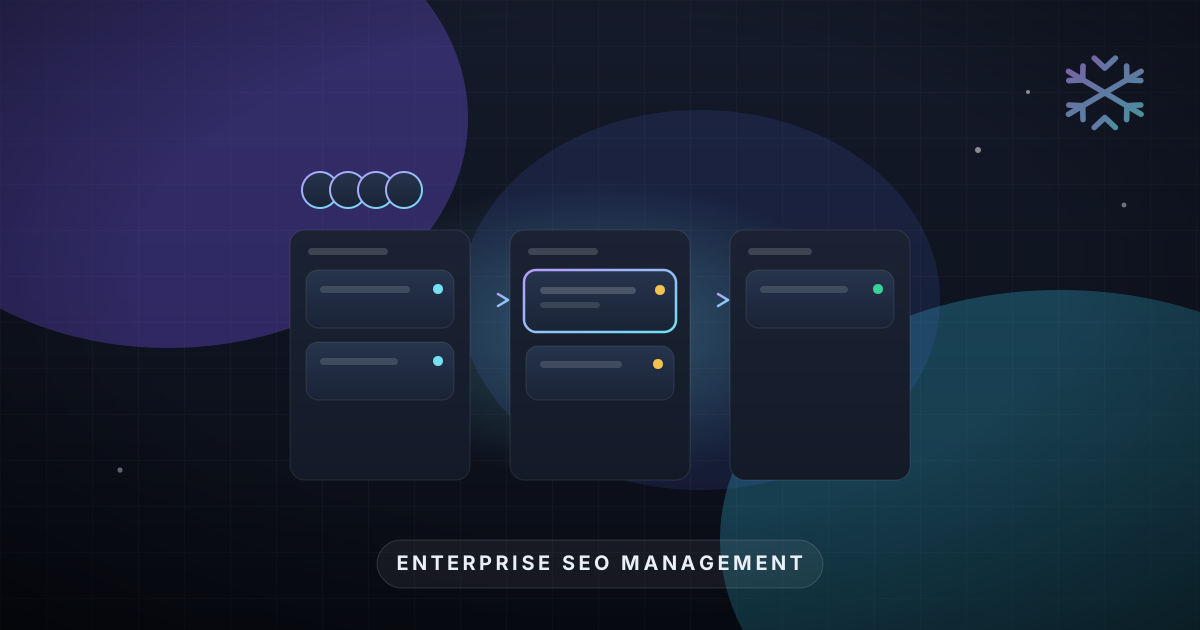
The biggest process shift mature teams make is dropping the long strategy document in favor of agile, incremental delivery. Instead of a six-month plan, work gets broken into one-to-four-week sprints, usually two-week cycles synced to the engineering calendar, each with a single clear goal, light ceremonies (planning, a short daily standup, a review, a retro), and a real definition of done.
What makes this work is pitching "snackable" changes instead of sweeping ones. Rather than asking leadership to bless a site-wide overhaul, you ship one tightly scoped change, say a homepage tweak, measure the lift in organic sessions, then use that proof to roll the same change out to category pages, then product pages. Rinse and repeat. It does two things at once: it de-risks the work, and it generates the evidence you'll need to keep earning investment. Syncing your cadence to the web, dev, and product sprints also means you're planning with your counterparts instead of lobbing requests over a wall, which is the whole difference between collaboration and the eternal ticket queue.
Prioritization: Deciding What Actually Gets Built
A program at scale generates way more ideas than it can ship, so the constraint shifts from coming up with work to choosing it. The most widely used framework is RICE: Reach times Impact times Confidence, divided by Effort. It was built on Intercom's growth team to compare projects against a single goal, and it scores confidence explicitly (100% for high, 80% for medium, 50% for low) to keep optimism honest. Lighter options like ICE, plus MoSCoW and WSJF, do the same job: turning a messy backlog into a ranked, defensible queue.
The operational key is that this backlog has to live where engineering already works, in Jira or whatever you use, with SEO tickets scheduled into engineering sprints like any other work, not parked in a separate spreadsheet developers never open. The scoring isn't about precision. It's about having a transparent, shared rationale when you tell a stakeholder why their pet project sits below something else. Cross-functional collaboration runs on that kind of legitimacy.
The Content Production Pipeline
Content at enterprise scale needs a repeatable pipeline with clear owners and quality gates, because the failure modes (thin auto-generated pages, keyword cannibalization, inconsistent voice) all come from process gaps, not talent gaps.
A pipeline that works runs through seven stages: ideation and keyword validation (owned by a strategist), a brief, a draft, an edit, SEO optimization, a legal or compliance review where the industry calls for it, and finally publish and distribute. The brief is the leverage point. It should be complete enough that a writer could produce a draft without a single follow-up question, because every ambiguity you leave in the brief turns into rework later. A realistic end-to-end lead time for an evergreen piece is fourteen to twenty-one days. AI-assisted briefing can shave a few days off drafting, but it won't compress editing or review, which is where quality actually gets protected.
Sitting above the pipeline is an editorial calendar that plans across horizons: annual themes into quarterly pillars into monthly briefs into weekly production, with every row carrying a status, an owner, a primary keyword, its topic cluster, the channel, and a success metric. The clusters matter for more than tidiness. Building pillar-and-cluster architecture with deliberate internal linking is how you establish topical authority, cover a subject completely before moving on, and increasingly how you earn visibility in AI answers, which weigh relevance across a lot of related sub-queries rather than a single keyword.
Two operational metrics tell you whether the pipeline is healthy: an on-time publication rate above roughly 85%, and a first-pass approval rate that's trending up. A low first-pass rate is almost always a brief-quality problem wearing a writing-quality costume. And because AI Overviews are speeding up content decay, refresh cycles that used to run once a year now often need to run every six to eight months.
Technical Governance at Scale
Because a templating error spreads across thousands of pages, technical SEO at this level is really a governance discipline: written standards plus actual enforcement. The standards cover the predictable risks (crawl-budget waste, faceted-navigation sprawl, JavaScript rendering, canonical and indexation rules), and the enforcement happens through review before deploys and automated monitoring that catches breakages the moment they ship, not the next time someone happens to run a crawl.
This is where continuous crawling and automated quality checks pay for themselves. Real-time monitoring flags a sudden spike in noindex tags or a broken canonical within hours, and CI/CD validation can block a deploy that would've shipped malformed hreflang. The goal is to push the cost of catching an error close to zero, so the systems nature of the problem works for you instead of against you.
Breaking the Silos: Cross-Functional Collaboration and the KPI Trap
The deepest enterprise SEO problems are rarely technical. They come from structural silos and what's worth calling the KPI trap: every neighboring team is measured on something that isn't organic search, so organic search ends up being nobody's priority. Developers optimize for delivery speed, content for brand consistency, paid for ROAS, and the SEO work that depends on all three falls through the cracks.
The fix that lasts is making organic performance a shared indicator. Put it on the scorecards of the teams whose work affects it, and run a regular cross-functional business review with SEO, marketing, engineering, and product in the same room looking at the same numbers. Where a fully central team isn't realistic, designated liaisons or champions inside each department become the connective tissue, carrying standards out and context back.
Content silos and fragmented site architecture are symptoms. Misaligned incentives are the disease.
Managing SEO Across Many Brands, Sites, and Regions
Multi-brand, multi-site, and international operations are where governance stops being advice and becomes the entire job. The first decisions are architectural. For international SEO, subfolders have become the favored 2026 approach because they consolidate domain authority and are far easier to manage than country-code domains, which send strong local signals but cost a fortune to maintain, or subdomains, which can dilute equity.
The recurring trip-wire is hreflang. Manual implementation just doesn't survive at scale, and a big share of international sites carry hreflang errors as a result. A workable governance framework handles hreflang through XML sitemaps or an automated system, keeps a single language-mapping database as the source of truth, and validates on every deploy through CI/CD. Pair that with a "global asset, local localization" content model, where headquarters produces core assets and regional teams localize them for real cultural and search-intent differences rather than just translating, and you get the standardization the brand needs without losing the local relevance that actually ranks.
3M's program is a good picture of this scale: organic search across five major businesses, sixty divisions, a hundred countries, and roughly six thousand websites, with organic responsible for 45% of traffic. The team's answer wasn't more headcount. It was an "SEO council" pulling in IT, data management, UX, and content, plus a measurement approach that tied organic data to conversions so every click carried a dollar value. Per BrightEdge's case study, that delivered 20% year-over-year organic growth for three straight years and, on a single business unit and a single topic, about $25,000 a month in incremental value: a per-topic proof point built to be copied across thousands of products. (As with most vendor-published numbers, treat the specifics as illustrative rather than independently audited.)
Proving ROI in the Language of the Business
None of this is fundable unless you can prove value in terms an executive cares about, and that means retiring the vanity metrics. Raw traffic, average position, and domain authority describe activity, not outcomes. The reporting stack that keeps the investment flowing leads with organic-sourced pipeline and revenue, revenue per visit, customer acquisition cost against paid channels, lifetime value, and the growth of branded versus non-branded queries. The base calculation is just revenue from SEO minus its cost, divided by cost.
The reframing that actually lands in a boardroom is positioning SEO as the most cost-efficient acquisition channel you've got, lower CAC than paid and higher LTV from the customers it brings in, instead of pitching it as a traffic machine. Getting there means stitching together GA4, Search Console, the CRM, and a warehouse like BigQuery, and ditching last-click attribution, which systematically undervalues a channel that does most of its work early in the funnel. This is the heart of SEO analytics done right. Report business outcomes monthly with the rankings and technical detail below the fold, and go deeper quarterly.
The best reporting does less, not more.
One measurement caveat now belongs on every enterprise dashboard. AI Overviews are sharply cutting clicks on informational queries. Ahrefs' December 2025 analysis of 300,000 keywords found that the presence of an AI Overview correlated with a 58% lower clickthrough rate for the top-ranking page, and a randomized field experiment from researchers at the Indian School of Business and Carnegie Mellon found AI Overviews cut organic clicks to external sites by 38% on the queries where they appear, with zero-click searches climbing from 54% to 72%. The takeaway is that falling click volume on informational terms might signal a change in the search interface rather than a drop in your performance, so the numbers to watch are the conversion rate of the sessions you do get and the growth of branded, high-intent demand, not raw clicks. (I dig into this data in Enterprise SEO Statistics: Key Benchmarks and Data for 2026.)
The New Layer: Managing for AI Search
Which lands the whole operating model on its current test. Answer engine optimization and generative engine optimization, getting cited and represented accurately inside AI-generated answers, have become a parallel channel that enterprises now staff, fund, and measure right alongside traditional search. Conductor's 2026 research found enterprises putting an average of around 12% of digital marketing budgets toward AI visibility, with most building the capability in-house rather than outsourcing it.
The honest framing is that it's early. Conductor's 2026 AEO/GEO benchmarks show AI answers now appearing in roughly one in four Google queries, while AI referral traffic is still around 1% of sessions, and the survey populations skew toward advanced, already-invested organizations. The case for moving now rests as much on positioning as on present-day traffic. The reassuring part, if you've built the foundation this article describes, is that AEO and GEO don't need a separate machine. The same topical-authority architecture, the same content quality gates, the same technical governance, and the same cross-functional discipline are what feed AI visibility too. A well-run program just extends into AI search.
A well-run program just extends into AI search. A badly governed one now has two channels it can't manage.
A Staged Roadmap for Building the Capability
None of this gets built at once. The realistic path runs in three stages.
In the first ninety days, the work is foundational. Secure an executive sponsor, decide where SEO lives (a small central team or CoE is the safe default), run a maturity assessment and a technical audit, and, before anything else, stand up revenue-tied measurement across GA4, Search Console, and the CRM. You'll know you're ready to move on when you've got a working session-to-revenue report and at least one KPI shared with another department.
Over the next three to nine months, you build the operating system. Pick the team structure that fits your business model, hire in priority order (lead, then technical, then content, then analyst), and embed an SEO engineer or a formal review gate in engineering. Install the agile cadence, the scored backlog in Jira, the seven-stage content pipeline with templates, and a documented knowledge base. Choose your platform stack by your actual bottleneck, not the longest feature list: a technical bottleneck points toward a crawl-focused platform, a content-velocity bottleneck toward a content suite, an authority gap toward backlink tooling, and an executive-reporting gap toward a reporting-strong platform. No single tool is great at everything, so most enterprises run a deliberate combination. The signs of health here are an on-time publication rate above 85% and a time-to-publish that keeps dropping.
From nine months on, you scale and govern: subfolder architecture and automated hreflang for international, topical-authority clusters tied to revenue pages, quarterly business reviews, and the AEO/GEO layer with its own budget and citation-tracking metrics. The outcomes that tell you it's working are a falling organic CAC and a growing share of branded queries and AI citations.
One simple resourcing rule sits underneath the whole journey. Below roughly $5M in revenue, outsource. From about $5M to $50M, run a hybrid model where an in-house lead owns strategy and an agency executes. Above $50M, build in-house with agency support for surge and specialist work. Revisit it the moment monthly SEO spend crosses about $15,000, where in-house economics start to win, or when AI referral traffic becomes material in your category.
Enterprise SEO that scales isn't the product of better tactics than the next company's. It's the product of a clear home in the org, a team structure that matches the business, workflows that ship like a product team's, governance that stops small errors from becoming big ones, and measurement that speaks the language of revenue. Build that, and the tactics, including the ones AI search is about to demand, become things you can actually execute. Skip it, and you'll keep doing excellent SEO that never quite makes it to the page.
If you want a second set of eyes on how your SEO program is structured, or where it's quietly leaking value, that's the kind of thing I help with.